The Art of David Harrison Vermont Artist Google Sites
| The Band | |
|---|---|
 The Band in 1969: (left to correct) Manuel, Hudson, Captain, Robertson, Danko | |
| Background information | |
| Also known as | Levon and the Hawks Canadian Squires The Crackers |
| Origin | Toronto, Ontario, Canada Woodstock, New York, U.Due south. |
| Genres |
|
| Years active | 1967 (1967)–1977, 1983–1999 |
| Labels | Capitol/EMI, Rhinoceros, Warner Bros. |
| Associated acts | Ronnie Hawkins, Bob Dylan, John Simon, Allen Toussaint, Cate Brothers, Ringo Starr & His All-Starr Band, Van Morrison, The Weight Ring |
| By members | Rick Danko Levon Helm Garth Hudson Richard Manuel Robbie Robertson Jim Weider Stan Szelest Randy Ciarlante Richard Bell |
The Band was a Canadian-American rock band formed in Toronto, Ontario, in 1967. Information technology consisted of four Canadians and one American: Rick Danko (bass guitar, vocals, dabble), Garth Hudson (keyboards, accordion, saxophone), Richard Manuel (keyboards, drums, lap steel guitar, vocals), Robbie Robertson (guitar, vocals), and Levon Helm (drums, vocals, mandolin, guitar). The Band combined elements of Americana, folk, rock, jazz, country, and R&B, influencing subsequent musicians such every bit the Eagles, Elton John, the Grateful Expressionless, Eric Clapton and Wilco.
Between 1958 and 1963, the group was known as the Hawks, a backing band for rockabilly vocalist Ronnie Hawkins. In the mid-1960s, they gained recognition for backing Bob Dylan, and the 1966 concert tour was notable as Dylan'southward first with an electric band. After leaving Dylan and changing their name to "The Band", they released several records to critical and popular acclaim, including their debut album Music from Big Pinkish, in 1968. According to AllMusic, the album's influence on several generations of musicians has been substantial: musician Roger Waters called Music from Big Pink the second-nearly influential tape in the history of rock and roll,[2] and music journalist Al Aronowitz called it "country soul ... a audio never heard earlier".[3] Their about popular songs included "The Weight","The Dark They Collection Quondam Dixie Down" and "Up on Cripple Creek".
Music critic Bruce Eder described the Band as "one of the most pop and influential rock groups in the world, their music embraced by critics ... equally seriously as the music of the Beatles and the Rolling Stones."[4] The Ring was inducted into the Canadian Music Hall of Fame in 1989 and the Rock and Roll Hall of Fame in 1994.[5] [6] In 2004, Rolling Rock ranked them 50th on its list of the 100 greatest artists of all time,[vii] while ranking "The Weight" 41st on its list of the 500 greatest songs of all fourth dimension.[eight] In 2008, the group received the Grammy Lifetime Achievement Honour,[nine] and in 2014, they were inducted into Canada's Walk of Fame.[10]
History [edit]
1957–1964: The Hawks [edit]
The members of the Band gradually came together in the Hawks, the bankroll group for Toronto-based rockabilly singer Ronnie Hawkins: Captain began playing with the group in 1957, then became their fulltime drummer after graduating from high school in 1958. He journeyed with Hawkins from Arkansas to Ontario, where they were joined by Robertson, Danko, Manuel, and finally Hudson. Latter-day Band member Stan Szelest was also in the grouping at that fourth dimension. Hawkins's act was popular in and around Toronto and nearby Hamilton,[11] and he had an effective way of eliminating his musical competition: when a promising ring appeared, Hawkins would rent their best musicians for his own group; Robertson, Danko, and Manuel came under Hawkins'south tutelage this mode.
While most of the Hawks were eager to join Hawkins'south group, getting Hudson to join was a different story. He had earned a college degree, planned on a career as a music teacher, and was interested in playing rock music only as a hobby. The Hawks admired his wild, full-bore organ style and asked him repeatedly to bring together. Hudson finally agreed, under the condition that the Hawks each pay him $10 per week to be their instructor and purchase a new land-of-the-art Lowrey organ; all music theory questions were directed to Hudson.
There is a view that jazz is 'evil' considering information technology comes from evil people, but actually the greatest priests on 52nd Street, and on the streets of New York City were the musicians. They were doing the greatest healing work. And they knew how to punch through music which would cure and make people experience good.
—Garth Hudson, in The Last Waltz
With Hawkins, they recorded a few singles in this period and became well known as the best stone grouping in the thriving Toronto music scene. Hawkins regularly convened all-night rehearsals post-obit long club shows, with the result that the young musicians quickly developed great technical prowess on their instruments.
In tardily 1963, the group separate from Hawkins over personal differences. They were tired of playing the same songs and then often and wanted to perform original material, and they were wary of Hawkins's heavy-handed leadership. He would fine the Hawks if they brought their girlfriends to the clubs (fearing it might reduce the numbers of "bachelor" girls who came to performances) or if they smoked marijuana.
Robertson later on said, "Eventually, [Hawkins] built us up to the point where we outgrew his music and had to go out. He shot himself in the foot, actually, bless his heart, by sharpening us into such a crackerjack band that we had to go on out into the globe, considering we knew what his vision was for himself, and we were all younger and more ambitious musically."[12]
Upon leaving Hawkins, the group was briefly known as the Levon Captain Sextet, with sixth fellow member sax player Jerry Penfound, and then as Levon and the Hawks afterwards Penfound's divergence. In 1965, they released a single on Ware Records under the proper name the Canadian Squires, only they returned as Levon and the Hawks for a recording session for Atco afterward that year.[13] Also in 1965, Helm and the band met blues singer and harmonica player Sonny Male child Williamson. They wanted to record with him, offer to become his backing band, but Williamson died not long after their meeting.
Later in 1965 Bob Dylan hired them for his U.South. bout in 1965 and world bout in 1966.[14] Following the 1966 tour, the group moved with help from Dylan and his managing director, Albert Grossman, to Saugerties, New York, where they made the informal 1967 recordings that became The Basement Tapes, the basis for their 1968 debut album, Music from Big Pinkish. Considering they were always "the ring" to various frontmen and the locals in Woodstock, Captain said the name "the Band" worked well when the group came into its own.[fifteen] [a] The group began performing as the Band in 1968 and went on to release x studio albums. Dylan continued to collaborate with the Band over the course of their career, including a articulation 1974 tour.[17]
1965–1967: With Bob Dylan [edit]

In late summertime 1965, Bob Dylan was looking for a backup band for his first U.S. "electric" tour. Levon and the Hawks were recommended by dejection vocaliser John Hammond Jr., who earlier that year had recorded with Helm, Hudson and Robertson on his Vanguard album So Many Roads.[xviii] [nineteen] Around the same time, one of their friends from Toronto, Mary Martin, was working as secretary to Dylan's managing director, Albert Grossman. She told Dylan to visit the group at Le Coq d'Or Tavern, a club on Yonge Street, in Toronto—though Robertson recollects it was the Friar's Tavern, just down the street.[20] Her advice to Dylan: "You gotta see these guys."[21]
After hearing the band play and meeting with Robertson, Dylan invited Helm and Robertson to join his backing ring. After ii concerts bankroll Dylan, Helm and Robertson told Dylan of their loyalty to their bandmates and told him that they would continue with him only if he hired all of the Hawks. Dylan accepted and invited Levon and the Hawks to tour with him. The group was receptive to the offering, knowing it could give them the wider exposure they craved. They thought of themselves as a tightly rehearsed stone and rhythm and blues grouping and knew Dylan mostly from his early acoustic folk and protest music. Furthermore, they had footling inkling of how internationally popular Dylan had become.[22]
With Dylan, the Hawks played a series of concerts from September 1965 through May 1966, billed as Bob Dylan and the Ring. The tours were marked by Dylan's reportedly copious apply of amphetamines. Some, though not all, of the Hawks joined in the excesses.[23] Near of the concerts were met with heckling and disapproval from folk music purists. Captain was and then affected by the negative reception that he left the tour after a lilliputian more than i month and sat out the rest of that year's concerts, as well as the world tour in 1966.[24] Helm spent much of this period working on an oil rig in the Gulf of United mexican states.[25]
During and between tours, Dylan and the Hawks attempted several recording sessions, but with less than satisfying results. Sessions in October and Nov yielded but one usable single ("Can You Please Crawl Out Your Window?"), and ii days of recording in January 1966 for what was intended to exist Dylan's next anthology, Blonde on Blonde, resulted in "One of Us Must Know (Sooner or Later)", which was released equally a single a few weeks later and was subsequently selected for the album.[26] On "One of Us Must Know", Dylan was backed by drummer Bobby Gregg, bassist Danko (or Neb Lee),[b] guitarist Robbie Robertson, pianist Paul Griffin, and Al Kooper (who was more a guitarist than an organist) playing organ.[27] Frustrated by the wearisome progress in the New York studio, Dylan accepted the suggestion of producer Bob Johnston and moved the recording sessions to Nashville. In Nashville, Robertson's guitar was prominent on the Blonde on Blonde recordings, especially "Leopard-Skin Pill-Box Hat", merely the other members of the Hawks did non attend the sessions.
During the European leg of their 1966 bout, Mickey Jones replaced Sandy Konikoff on drums. Dylan and the Hawks played at the Gratis Merchandise Hall in Manchester on May 17, 1966. The gig became legendary when, well-nigh the end of Dylan's electric set, an audience member shouted "Judas!" After a pause, Dylan replied, "I don't believe you lot. You lot're a liar!" He then turned to the Hawks and said, "Play information technology fucking loud!" With that, they launched into an acidic version of "Like a Rolling Stone".[28]
The Manchester performance was widely bootlegged (and mistakenly placed at the Majestic Albert Hall). In a 1971 review for Creem magazine, critic Dave Marsh wrote, "My response is that crystallization of everything that is rock'n'roll music, at its finest, was to allow my jaw to drop, my body to move, to leap out of the chair ... It is an experience that one desires simply to share, to play over and over once again for those he knows thirst for such pleasure. If I speak in an almost worshipful sense virtually this music, it is not because I have lost perspective, it is precisely considering I have found information technology, within music, yes, that was made five years agone. Merely it is there and unignorable."[29] When information technology finally saw official release in 1998, critic Richie Unterberger declared the record "an important document of rock history."[30]
On July 29, 1966, while on a interruption from touring, Dylan was injured in a motorcycle accident that precipitated his retreat into semi-seclusion in Woodstock, New York.[31] For a while, the Hawks returned to the bar and roadhouse touring circuit, sometimes backing other singers, including a brief stint with Tiny Tim. Dylan invited the Hawks to join him in Woodstock in February 1967,[32] and Danko, Manuel and Hudson rented a large pink house, which they named "Big Pink", in nearby W Saugerties, New York. The adjacent calendar month (initially without Captain) they commenced recording a much-bootlegged and influential serial of demos, initially at Dylan's business firm in Woodstock and later at Big Pink, which were released partially on LP as The Basement Tapes in 1975 and in total in 2014. A runway-by-rails review of the bootleg was detailed by Jann Wenner in Rolling Stone, in which the ring members were explicitly named and given the collective proper noun "the Crackers".[33]
1968–1972: Initial success [edit]

L to R: Danko, Helm and Manuel on bout in Hamburg, Germany, in 1971
The sessions with Dylan ended in October 1967, with Helm having rejoined the group by that time, and the Hawks began writing their ain songs at Large Pink. When they went into the recording studio, they still did not take a name for themselves. Stories vary as to the manner in which they ultimately adopted the name "the Band". In The Last Flit, Manuel claimed that they wanted to telephone call themselves either "the Honkies" or "the Crackers" (which they used when backing Dylan for a January 1968 concert tribute to Woody Guthrie), but these names were vetoed by their record label; Robertson suggests that during their time with Dylan anybody only referred to them as "the ring" and the name stuck. Initially they disliked the moniker, only somewhen they grew to like information technology, thinking it both humble and presumptuous. In 1969, Rolling Stone referred to them equally "the band from Big Pinkish."[34]
Their first album, Music from Big Pink (1968) was widely acclaimed. The album included three songs written or co-written by Dylan ("This Bicycle'southward on Fire", "Tears of Rage", and "I Shall Be Released") as well every bit "The Weight", the apply of which in the picture Easy Rider would make it one of their best-known songs. While a continuity ran through the music, the style varied by song.
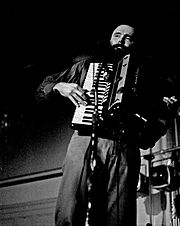
In spring 1969, afterward the success of Music from Big Pink, the Ring went on tour. Their first live appearance was at Winterland Ballroom. That summer they performed at the Woodstock Festival (their performance was not included in the famed Woodstock motion picture because of legal complications), and subsequently that year they performed with Dylan at the UK Isle of Wight Festival (several songs from which were after included on Dylan's Self Portrait album). That same year, they left for Los Angeles to record their follow-up, The Ring (1969). From their rustic advent on the cover to the songs and arrangements inside, the album stood in contrast to other popular music of the day. (Several other artists made similar stylistic moves most the same time, notably Dylan, on John Wesley Harding, which was written during the Basement Tapes sessions, and the Byrds, on Sweetheart of the Rodeo, which featured two Basement Tapes covers.) The Band featured songs that evoked old-fourth dimension rural America, from the Civil War in "The Night They Collection Erstwhile Dixie Downwardly" to the unionization of farm workers in "King Harvest (Has Surely Come up)".
These first two records were produced by John Simon, who was practically a group member: he aided in arrangements in addition to playing occasional piano and tuba. Simon reported that he was often asked about the distinctive horn sections featured so effectively on the beginning 2 albums: people wanted to know how they had achieved such memorable sounds. Simon stated that, as well Hudson (an accomplished saxophonist), the others had only rudimentary horn skills, and achieved their sound simply by creatively utilizing their limited technique.
Rolling Rock lavished praise on the Band in this era, giving them more attention than perhaps any other group in the magazine's history; Greil Marcus's manufactures contributed to the Band's mystique. The Band was besides featured on the cover of Fourth dimension magazine (January 12, 1970), the start rock grouping after the Beatles, over ii years before, to achieve this rare stardom.[35] David Attie'southward unused photographs for this cover—among the very few studio portraits taken during the Band's prime—accept just recently been discovered, and were featured in Daniel Roher'southward Robbie Robertson documentary Once Were Brothers: Robbie Robertson and The Band, equally well as having their own four-page spread in Harvey Kubernik and Ken Kubernik's "The Story of the Band: From Large Pink to The Terminal Waltz" (Sterling Publishing, 2018).[36]
A critical and commercial triumph, The Band, forth with works past the Byrds and the Flying Burrito Brothers, established a musical template (sometimes dubbed country stone) that paved the manner to the Eagles. Both Big Pink and The Ring also influenced their musical contemporaries. Eric Clapton and George Harrison cited the Band as a major influence on their musical direction in the late 1960s and early 1970s. Clapton later on revealed that he wanted to join the group.[37]
Following their second album, the Band embarked on their first tour as a lead act. The anxiety of fame was clear, every bit the group'southward songs turned to darker themes of fear and breach: the influence on their next piece of work is cocky-explanatory. Stage Fear (1970) was engineered by musician-engineer-producer Todd Rundgren and recorded on a theatre stage in Woodstock. Equally with their previous, cocky-titled record, Robertson was credited with most of the songwriting. Initial critical reaction was good only it was seen every bit a letdown from the previous 2 albums, because of the darker subject matter. But contemporary critics have reevaluated Phase Fear and institute it equal to, if not dissimilar from, their first two albums.
After recording Stage Fright, the Band was among the acts participating in the Festival Express, an all-star rock concert tour of Canada by railroad train that also included Janis Joplin, the Grateful Expressionless and hereafter Band member Richard Bell (at the time he was a member of Joplin's ring). In the concert documentary picture show, released in 2003, Danko can exist seen participating in a drunken jam session with Jerry Garcia, Bob Weir and Joplin while singing "Ain't No More Cane".
At about this fourth dimension, Robertson began exerting greater control over the Band, a point of contention between Captain and Robertson. Helm charges Robertson with authoritarianism and greed, while Robertson suggests his increased efforts in guiding the grouping were largely considering Helm, Danko and Manuel were becoming more unreliable due to their heroin usage.[38] Robertson insists he did his all-time to coax Manuel into writing more songs, only to meet him descend into addiction.
Despite mounting issues among the grouping members, the Ring forged ahead with their next album, Cahoots (1971). Cahoots featured Bob Dylan's "When I Paint My Masterpiece", "4% Pantomime" (with Van Morrison), and "Life Is a Funfair", the last featuring a horn arrangement by Allen Toussaint. Toussaint's contribution was a critical addition to the Band's next projection, and the grouping would later record two songs written past Toussaint: "Holy Cow" (on Moondog Matinee) and "Yous See Me" (on Jubilation).
In late December 1971, the Band recorded the live anthology Rock of Ages, which was released in the summer of 1972. On Rock of Ages, they were bolstered by the add-on of a horn department, with arrangements written by Toussaint. Bob Dylan appeared on phase on New year's Eve and performed four songs with the group, including a version of "When I Paint My Masterpiece".
1973–1975: Move to Shangri-La [edit]
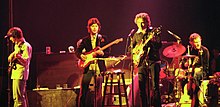
Bob Dylan and the Band in Chicago, 1974: (left to right) Danko, Robertson, Dylan and Captain
In 1973, the Band released Moondog Matinee, an album of old songs written by non-Band members. There was no tour in back up of the anthology, which garnered mixed reviews. However on July 28, 1973, they played at the legendary Summer Jam at Watkins Glen, a massive concert that took identify at the Thou Prix Raceway exterior Watkins Glen, New York. The event, which was attended past over 600,000 music fans, too featured the Grateful Dead and the Allman Brothers Band. It was during this consequence that discussions began about a possible tour with Bob Dylan, who had moved to Malibu, California, forth with Robertson. Past tardily 1973, Danko, Helm, Hudson and Manuel had joined them, and the first lodge of business concern was bankroll Dylan on the album Planet Waves. The album was released concurrently with their joint 1974 tour, in which they played forty shows in North America during January and February 1974. Later that year, the alive album Before the Flood was released, which documents the bout.
During this fourth dimension, the Band brought in Planet Waves producer Rob Fraboni to help blueprint a music studio for the group. Past 1975, the studio—known equally Shangri-La—was completed. That yr, the Band recorded and released Northern Lights – Southern Cross, their first album of all-new textile since 1971's Cahoots. All eight songs were written exclusively by Robertson. Despite comparatively poor tape sales, the album is favored by critics and fans alike. Levon Helm regards this album highly in his volume, This Wheel's on Fire: "It was the best anthology nosotros had done since The Ring." The album also produced more experimentation from Hudson, switching to synthesizers, showcased on "Jupiter Hollow".
1976–1978: The Terminal Waltz [edit]

The Band with guests at the Last Waltz concert. Photo: David Gans
By the mid-1970s, Robbie Robertson was weary of touring. Later Northern Lights – Southern Cross failed to meet commercial expectations, much of the group'south 1976 tour was confined to theaters and smaller arenas in secondary markets (including the Santa Cruz Civic Auditorium, the Long Island Arena and the Champlain Valley Expo in Essex Junction, Vermont), culminating in an opening slot for the ascendant Z.Z. Top at the Nashville Fairgrounds in September.[39] In early September, Richard Manuel suffered a severe neck injury in a boating accident in Texas,[xl] prompting Robertson to urge the Ring to retire from alive performances after staging a massive "farewell concert" known as The Last Waltz. Following an October 30 appearance on Saturday Night Alive, the event, including turkey dinner for the audience of 5,000, was held on Nov 25 (Thanksgiving Day) of 1976 at the Winterland Ballroom in San Francisco, California,[41] and featured a horn section with arrangements by Allen Toussaint and a stellar list of guests, including Canadian artists Joni Mitchell and Neil Young. Two of the guests were fundamental to the Band'south beingness and growth: Ronnie Hawkins and Bob Dylan. Other guests they admired (and in most cases had worked with earlier) included Muddy Waters, Dr. John, Van Morrison, Ringo Starr, Eric Clapton, Ron Woods, Bobby Charles, Neil Diamond, and Paul Butterfield. The concert was filmed by Robertson's friend, filmmaker Martin Scorsese.[42]
In 1977, the Band released their seventh studio anthology Islands, which fulfilled their record contract with Capitol so that a planned Last Waltz moving-picture show and album could be released on the Warner Bros. label. Islands contained a mix of originals and covers, and was the last with the Band'due south original lineup. That same year, the grouping recorded soundstage performances with country singer Emmylou Harris ("Evangeline") and gospel-soul group the Staple Singers ("The Weight"); Scorsese combined these new performances—too as interviews he had conducted with the group—with the 1976 concert footage. The resulting concert film–documentary was released in 1978, along with a three-LP soundtrack.
Captain afterward wrote about The Last Waltz in his autobiography, This Bike's on Fire, in which he fabricated the case that it had been primarily Robbie Robertson's project and that Robertson had forced the Band'south breakdown on the balance of the group.[43] Robertson offered a different take in a 1986 interview: "I made my big statement. I did the movie, I made a three-tape anthology about it—and if this is only my argument, not theirs, I'll accept that. They're saying, 'Well, that was really his trip, non our trip.' Well, fine. I'll have the best music moving-picture show that's ever been fabricated, and make it my statement. I don't accept whatever issues with that. None at all."[44]
The original quintet would perform together one last time, afterwards the late set up of Rick Danko's March ane, 1978, solo bear witness at The Roxy, performing "Stage Fear", "The Shape I'm In", and "The Weight" for an encore. This would exist the last time all five musicians would perform together.[45]
Although the members of the group intended to go along working on studio projects, they drifted autonomously after the release of Islands in March 1977.
1983–1989: Reformation and the loss of Richard Manuel [edit]
The Band resumed touring in 1983 without Robertson, who had found success with a solo career and as a Hollywood music producer. As a result of their macerated popularity, they performed in theaters and clubs every bit headliners and took back up slots in larger venues for quondam peers such every bit the Grateful Dead and Crosby, Stills and Nash.
After a functioning in Winter Park, Florida, on March 4, 1986, Manuel hanged himself, aged 42, in his motel room.[46] [47] He had suffered for many years from alcoholism and drug addiction and had been clean and sober for several years beginning in 1978 just had begun drinking and using drugs once again by 1984.[48] Manuel's position as pianist was filled past erstwhile friend Stan Szelest (who died not long afterward) and then by Richard Bell. Bell had played with Ronnie Hawkins after the departure of the original Hawks, and was all-time known from his days as a member of Janis Joplin's Total Tilt Boogie Band.
The Ring was inducted into the Canadian Music Hall of Fame at the 1989 Juno Awards, where Robertson was reunited with original members Danko and Hudson. With Canadian country rock superstars Blue Rodeo as a redundancy band, Music Express called the 1989 Juno appearance a symbolic "passing of the torch" from the Band to Bluish Rodeo.
1990–1999: Return to final recording [edit]
The remaining iii members continued to tour and tape albums with a succession of musicians filling Manuel'due south and Robertson'southward roles. The Band appeared at Bob Dylan'south 30th anniversary concert in New York Metropolis in Oct 1992, where they performed their version of Dylan'southward "When I Pigment My Masterpiece". In 1993, the group released their 8th studio album, Jericho. Without Robbie Robertson as primary lyricist, much of the songwriting for the album came from outside of the group. Besides that year, the Ring, along with Ronnie Hawkins, Bob Dylan, and other performers, appeared at U.Southward. President Bill Clinton's 1993 "Blue Jean Fustigate" inauguration party.[49]
In 1994 the Band performed at Woodstock '94. Later on that yr Robertson appeared with Danko and Hudson every bit the Band for the 2nd fourth dimension since the original group broke up. The occasion was the induction of the Band into the Rock and Coil Hall of Fame. Helm, who had been at odds with Robertson for years over accusations of stolen songwriting credits, did not attend.[l] In February 1996, the Band with the Crickets recorded "Not Fade Abroad", released on the tribute album Not Fade Away (Remembering Buddy Holly). The Band released two more albums after Jericho: High on the Hog (1996) and Jubilation (1998), the latter of which included guest appearances by Eric Clapton and John Hiatt. Captain was diagnosed with throat cancer in 1998 and was unable to sing for several years but he eventually regained the utilise of his vocalisation.
In 1998, the group revealed they were working on a follow-upward album to Jubilation that has non been released.[51]
The terminal song the grouping recorded together was their 1999 version of Bob Dylan's "One Too Many Mornings", which they contributed to the Dylan tribute album Tangled Up in Blues. On December 10, 1999, Rick Danko died in his sleep at the age of 56. Following his death, the Band bankrupt up for good. The concluding configuration of the group included Richard Bong (piano), Randy Ciarlante (drums), and Jim Weider (guitar).
2000–present [edit]
In 2002, Robertson bought all other former members' fiscal interests in the group (with the exception of Helm),[52] giving him major command of the presentation of the grouping's material, including latter-day compilations. Richard Bell died of multiple myeloma in June 2007.
The Band received a Lifetime Achievement Grammy Laurels on February nine, 2008,[53] only there was no reunion of all three living members. In honor of the event, Captain held a Midnight Constitutional in Woodstock.[54] He continued to perform and released several albums. On April 17, 2012, information technology was appear via Helm's official website that he was in the "final stages of cancer";[55] he died two days later.[56]
In December 2020, information technology was announced that the third album of The Band, Phase Fear, would go an expanded reissue. The album has alternate versions of some songs.[57]
Members' other endeavours [edit]
In 1977, Rick Danko released his eponymous debut solo album, which featured the other 4 members of the Ring on various tracks. In 1984, Danko joined members of the Byrds, the Flying Burrito Brothers, and others in the huge touring company that made up "The Byrds Twenty-Year Celebration". Several members of the tour performed solo songs to showtime the prove, including Danko, who performed "Mystery Train". Danko also released three solo albums in the 1990s, "In Concert", "Live on Cakewalk Hill" and "Times Like These" all three of these records were produced by Aaron L. Hurwitz and are on the Breeze Colina/Woodstock Records Characterization.[58]
In the late 70s and 80s, Helm released several solo albums and toured with a band called Levon Helm and the RCO Allstars. He as well began an acting career with his role equally Loretta Lynn's father in Coal Miner's Girl. Helm received praise for his narration and supporting part opposite Sam Shepard in 1983's The Right Stuff. In 1997 a CD by Levon Helm and the Crowmatix, Souvenir, was released.[59] Offset sometime in the 1990s, Captain regularly performed Midnight Ramble concerts at his home and studio in Woodstock, New York, and toured.[60] In 2007 Helm released a new album, an homage to his southern roots called Dirt Farmer, which was awarded a Grammy Award for All-time Traditional Folk Album on February 9, 2008. Electric Dirt followed in 2009 and won the inaugural Grammy Award for Best Americana Album. His 2011 live album Ramble at the Ryman was nominated in the aforementioned category and won.[61]
Later on he left the Band, Robbie Robertson became a music producer and wrote film soundtracks (including acting as music supervisor for several of Scorsese's films) before showtime a solo career with his Daniel Lanois-produced eponymous album in 1987.
Hudson has released 2 acclaimed solo CDs, The Bounding main to the North in 2001, produced past Aaron (Professor Louie) Hurwitz, and Live at the Wolf in 2005, both featuring his married woman, Maud, on vocals. He has too kept busy as an in-demand studio musician. He is featured extensively on recordings of the Call and land-indie star Neko Case. Hudson contributed an original electronic score to an off-Broadway production of Dragon Slayers, written by Stanley Keyes and directed by Brad Mays in 1986 at the Union Square Theatre in New York, which was restaged with a new cast in Los Angeles in 1990. In 2010, Hudson released Garth Hudson Presents: A Canadian Celebration of the Ring, featuring Canadian artists covering songs that were recorded past the Band.
In 2012, Jim Weider launched the Weight Band, performing covers of the Band's music, aslope old members of the Levon Helm Band and Rick Danko Group. Recently, the Weight Band performed in a nationally broadcast PBS special, Infinity Hall Live,[62] featuring new music. Post-obit the show, the band appear a cocky-titled album of new music. The Weight Band also hosts Military camp Cripple Creek, which celebrates the legacy of the Woodstock Sound. Past guests take included Jackie Greene, Music from Large Pink producer John Simon and John Sebastian.[63]
Manuel had few projects outside the Band; he and the residuum of the Band contributed to Eric Clapton's 1976 anthology No Reason to Cry. It included an original limerick by Manuel and featured his vocals and drumming on several tracks. Manuel later worked on several movie scores with Hudson and Robertson, including Raging Balderdash and The Colour of Coin.
Musical way [edit]

The Ring in Hamburg, 1971: (left to correct) Manuel, Danko, Robertson, and Captain
The Band's music fused many elements: primarily old state music and early rock and roll, though the rhythm section often was reminiscent of Stax- or Motown-mode rhythm and blues, and Robertson cites Curtis Mayfield and the Staple Singers as major influences, resulting in a synthesis of many musical genres. Singers Manuel, Danko, and Helm each brought a distinctive voice to the Band: Captain'south Southern accent was prevalent in his raw and powerful vocals, Danko sang tenor with a distinctively choppy enunciation, and Manuel alternated between falsetto and a soulful baritone. The singers regularly blended in harmonies. Though the singing was more than or less evenly shared among the three, both Danko and Helm have stated that they saw Manuel as the Band's "lead" vocalist.[64]
Every fellow member was a multi-instrumentalist. In that location was little musical instrument-switching when they played live, simply when recording, the musicians could make up different configurations in service of the songs. Hudson in particular was able to coax a wide range of timbres from his Lowrey organ. Helm'south drumming was ofttimes praised: critic Jon Carroll declared that Helm was "the only drummer who can make you lot cry," while prolific session drummer Jim Keltner admits to appropriating several of Helm's techniques.[65] Producer John Simon is oftentimes cited as a "6th member" of the Band for producing and playing on Music from Big Pink, co-producing and playing on The Band, and playing on other songs upward through the Band'southward 1993 reunion album Jericho.[66]
Copyright controversy [edit]
Robertson is credited as writer or co-writer of the majority of the Band's songs and, as a result, has received most of the songwriting royalties generated from the music. This would become a point of contention, especially for Captain. In his 1993 autobiography, This Cycle's on Fire: Levon Helm and the Story of the Ring, Helm disputed the validity of the songwriting credits as listed on the albums and explained that the Band'due south songs were developed in collaboration with all members. Danko concurred with Helm: "I think Levon's book hits the nail on the head about where Robbie and Albert Grossman and some of those people went wrong and when The Band stopped being The Band ... I'k truly friends with everybody just, hey—it could happen to Levon, too. When people take themselves too seriously and believe too much in their ain bullshit, they commonly make it trouble."[67] Robertson denied that Helm had written any of the songs attributed to Robertson.[68] The studio albums recorded by Levon Helm every bit a solo creative person—Levon Helm (1978), American Son, Levon Helm (1982), Dirt Farmer, and Electric Dirt—comprise simply one vocal crediting him every bit songwriter ("Growin' Merchandise", co-written with Larry Campbell).[69] [70]
Legacy [edit]
The Band has influenced numerous bands, songwriters and performers, including the Grateful Dead; Eric Clapton; George Harrison; Crosby, Stills, Nash & Young;[71] Led Zeppelin;[72] Elvis Costello;[73] Elton John;[74] Phish;[75] and Pink Floyd.[76]
The anthology Music from Big Pink, in item, is credited with contributing to Clapton's decision to leave the supergroup Foam. In his introduction of the Ring during the Bob Dylan 30th Anniversary Concert, Clapton appear that in 1968 he had heard the album, "and it inverse my life."[77] The band Nazareth took their name from a line in "The Weight". Guitarist Richard Thompson has acknowledged the anthology'due south influence on Fairport Convention's Liege and Lief, and journalist John Harris has suggested that the Band's debut also influenced the spirit of the Beatles' back-to-basics anthology Permit Information technology Exist as well every bit the Rolling Stones' string of roots-infused albums that began with Beggars Banquet.[78] [c] George Harrison said that his song "All Things Must Pass" was heavily influenced by the Band and that, while writing the vocal, he imagined Levon Helm singing information technology.[79] Meanwhile, the Music from Big Pinkish song "The Weight" has been covered numerous times, and in various musical styles. In a 1969 interview, Robbie Robertson remarked on the group'south influence, "We certainly didn't want everybody to go out and get a banjo and a fiddle player. Nosotros were trying to at-home things down a bit though. What we're going to do now is go to Musculus Shoals, Alabama, and tape four sides, four psychedelic songs. Full freak-me songs. Just to show that we have no difficult feelings. Just pretty proficient rock and roll."[80]
In the nineties, a new generation of bands influenced past the Band began to gain popularity, including Counting Crows, the Wallflowers, and the Black Crowes. Counting Crows indicated this influence with their tribute to the late Richard Manuel, "If I Could Give All My Love (Richard Manuel Is Dead)", from their anthology Hard Candy. The Black Crowes frequently cover songs by the Band during live performances, such as "The Night They Drove Old Dixie Downward", which appears on their DVD/CD Freak 'northward' Roll into the Fog.[81] They have also recorded at Helm's studio in Woodstock.
The inspiration for the classic rock-influenced ring the Concur Steady came while members Craig Finn and Tad Kubler were watching The Last Waltz.[82] Rick Danko and Robbie Robertson are proper noun-checked in the lyrics of "The Swish" from the Concord Steady's 2004 debut anthology Nigh Killed Me.[83] Also that year, southern rock-revivalists Drive-By Truckers released the Jason Isbell penned track "Danko/Manuel" on the anthology The Dingy Due south.
The Ring as well inspired Grace Potter, of Grace Potter and the Nocturnals, to course the ring in 2002. In an interview with the Montreal Gazette, Potter said, "The Band blew my mind. I idea if this is what Matt [Burr] meant when he said 'Permit's get-go a stone 'n' roll band,' ... that was the kind of rock 'north' coil ring I could believe in."[84]
A tribute album, entitled Endless Highway: The Music of the Band, released in January 2007, included contributions from My Morning Jacket, Decease Cab for Cutie, Gomez, Guster, Bruce Hornsby, Jack Johnson and ALO, Lee Ann Womack, the Allman Brothers Band, Blues Traveler, Jakob Dylan, Rosanne Cash, and others.
Members of Wilco, Clap Your Easily Say Yeah, the Shins, Dr Dog, Yellowbirds, Ween, Furthur, and other bands staged The Consummate Concluding Waltz in 2012 and 2013.[85] Their performances included all 41 songs from the original 1976 concert in sequence, even those edited out of the film. Musical director Sam Cohen of Yellowbirds claims "the flick is pretty ingrained in me. I've watched it probably 100 times."[85]
An incarnation of the Band'south legacy, The Weight Band, originated within the barn of Levon Helm in 2012 when Jim Weider and Randy Ciarlante, both former members of the Band, were performing "Songs of the Ring" with Garth Hudson, Jimmy Vivino and Byron Isaacs. In July 2017, PBS's Infinity Hall Live programme began airing a televised performance past the Weight Band, featuring Band covers and new music by the ring.[86]
Every yr on the Midweek before and the Fri later on Thanksgiving, Dayton, Ohio NPR affiliate WYSO and The Dayton Art Institute host a tribute to The Last Waltz.[87] Oftentimes selling out, the show features more than 30 local musicians. A similar consequence takes identify annually in Madison, Wisconsin, on the Saturday nighttime afterwards Thanksgiving.
The Band are the subjects of the 2019 documentary motion-picture show One time Were Brothers: Robbie Robertson and The Ring, which premiered at the 2019 Toronto International Film Festival.[88]
The Band is the subject field of an extensive historical podcast, The Band: A History, currently covering the entire history of the group.[89]
Members [edit]
| Years | Lineup |
|---|---|
| 1965–1967 |
|
| 1968–1977 |
|
| 1977–1983 | Disbanded |
| 1983–1985 |
|
| 1985–1986 |
|
| 1986–1989 |
|
| 1990 |
|
| 1990–1991 |
|
| 1991 |
|
| 1992–1999 |
|
Timeline [edit]
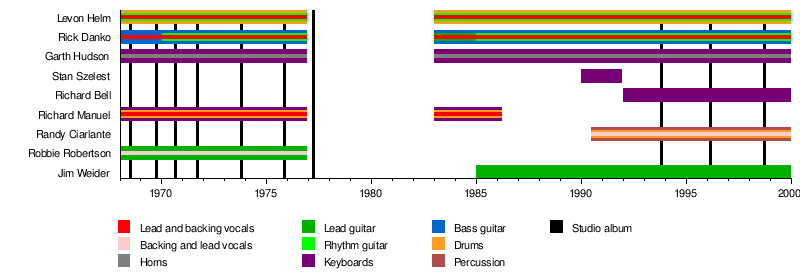
Discography [edit]
See also [edit]
- American stone
- Canadian rock
- Music of Canada
- Music of the United states of america
Notes [edit]
- ^ According to Alan Livingston, who as president of EMI records first signed them in 1968, the grouping'due south manager at the time came upwards with the moniker afterward Livingston insisted that they requite themselves a name.[xvi]
- ^ The booklet accompanying The Original Mono Recordings reissue of Blonde on Blonde lists Will Lee as the bass thespian (Marcus, Greil. Album notes for The Original Mono Recordings by Bob Dylan, 2010). Sean Wilentz insists that "the playing and talk on the Blonde on Blonde session tape show conclusively that Danko was the bassist on 'One of United states of america Must Know' (Wilentz, Sean. Bob Dylan in America, 2009, p. 113).
- ^ The recording sessions for Beggars Banquet, however, wrapped upwards in the aforementioned month that Music from Big Pinkish was released.
Citations [edit]
- ^ Vocalisation of Youth Advocates. Vol. 8 (2-6 ed.). Scarecrow Press. 1985. p. 153.
- ^ Moon, Tom (June 1, 2018). "50 Years On, The Band'south 'Music From Big Pinkish' Haunts U.s. All the same". NPR. Retrieved December x, 2020.
- ^ "The Beginnings of the Band: Getting Started, Meeting Bob Dylan and 'Music From Big Pink'". Rolling Stone. Baronial 24, 1968. Retrieved Feb 27, 2020.
- ^ "The Band | Biography & History". AllMusic.
- ^ "Canadian Music Hall of Fame". Carasonline.ca . Retrieved January 4, 2014.
- ^ "The Band". Rockhall.com . Retrieved January 4, 2014.
- ^ Williams, Lucinda (April 15, 2004). "The Immortals – The Greatest Artists of All Fourth dimension: 50, The Band". Rolling Stone . Retrieved June 20, 2017.
- ^ "The RS 500 Greatest Songs of All Fourth dimension". RollingStone.com. Archived from the original on April 16, 2007. Retrieved June 2, 2007.
- ^ "Lifetime Accomplishment Award". Grammy.com . Retrieved December 28, 2008.
- ^ "Canada's Walk of Fame". Canada'due south Walk of Fame . Retrieved Baronial seven, 2019.
- ^ Graham Rockingham. "Branding Hamilton as a music urban center". Hamilton Spectator, Nov ix, 2016.
- ^ "Andy Gill: Back to the Country". Theband.hiof.no . Retrieved January 21, 2009.
- ^ Grey, 33, 37.
- ^ Heylin, Clinton (2003). Behind the Shades Revisited. New York: HarperCollins. pp. 223–260. ISBN0-06-052569-X.
- ^ Hoskyns, Barney (1993). Across the Great Divide: The Band and America . Hyperion. pp. 144–145. ISBNone-56282-836-3.
- ^ "How the '60s Grouping The Band Got Their Name". YouTube. Archived from the original on October 28, 2021. Retrieved April 24, 2014.
- ^ Kreps, Daniel (September viii, 2009). "1974 Bob Dylan & the Band Bear witness Unearthed In Wolfgang's Vault". Rolling Stone . Retrieved August seven, 2019.
- ^ Heylin, 173–174.
- ^ Gray, 292–293.
- ^ MacDonald, Bruce. "Part 2 (1960–1965): Clip 6". Yonge Street: Toronto Rock & Curlicue Stories. Toronto: Bravo Canada. Archived from the original (Video) on January 21, 2012. Retrieved May 14, 2011.
- ^ Hoskyns, 85–86.
- ^ Hoskyns, 94–97.
- ^ Hoskyns, 104.
- ^ Grey, 33.
- ^ Helm, Levon; Davis, Stephen (1993). This Wheel'due south on Fire: Levon Helm and the Story of the Band. New York: William Morrow & Company. p. 143. ISBN9781613748763.
- ^ Heylin, Clinton. Revolution in the Air: The Songs of Bob Dylan, 1957–73, 2009, pp. 285–286
- ^ Björner, Olof (June 3, 2011). "Columbia Recording Studios, New York Urban center, New York, 25 January 1966". Bjorner's Still On The Road. Retrieved February half dozen, 2012.
- ^ Sounes, 213–215.
- ^ "Review of Dylan/Hawks, 1966". Theband.hiof.no. June 3, 1971. Retrieved January 21, 2009.
- ^ Unterberger, Richie (May 17, 1966). "( The Bootleg Serial, Vol. 4: The "Regal Albert Hall" Concert > Overview )". allmusic . Retrieved January 21, 2009.
- ^ Sounes, 216–218.
- ^ The Basement Tapes Raw. Legacy Recordings 88875019672, 2014, liner notes, p. three.
- ^ Jann Wenner (June 22, 1968). "Dylan'south Basement Tape Should Be Released". Rolling Stone . Retrieved June vi, 2013.
- ^ "Big Pink Ring To Tour U.Due south.". Rolling Rock. No. 30. April 5, 1969. p. 9.
- ^ "Time Magazine Cover: The Band – Jan. 12, 1970 – Stone – Singers – Music". Time. January 12, 1970. Archived from the original on February half dozen, 2007. Retrieved Jan 21, 2009.
- ^ Kubernik, Harvey & Kenneth, The Story of The band, 2018, Sterling: p122-125.
- ^ "Eric Clapton – Derek and The Dominos – Layla & Other Assorted..." Uncut.co.uk . Retrieved January 21, 2009.
- ^ Hunker, Ian (December eight, 2016). "Robbie Robertson Offers His Story of The Ring". The New Yorker . Retrieved December 29, 2017.
- ^ "The Band In Concert, 1976" (PDF). theband.hiof.no. Nov 2018.
- ^ Patrick Snyder (December 16, 1976). "The Band: Drifting Toward the Last Waltz". Rollingstone.com . Retrieved October 29, 2015.
- ^ Fricke, David, November 2001. The Concluding Waltz liner notes, 2002 CD re-issue, p. 17.
- ^ Fear, David (November 25, 2016). "Why the Band's 'The Last Waltz' Is the Best Concert Movie of All Time". Rolling Stone . Retrieved August seven, 2019.
- ^ Levon Helm and Stephen Davis. This Wheel'south on Fire: Levon Helm and the Story of the Ring, Affiliate Nine: The Last Waltz
- ^ "Edward Kiersh: Robbie Robertson of The Band". Theband.hiof.no . Retrieved January 2, 2020.
- ^ Bernstein, Scott (Feb 22, 2012). "Grousing the Aisles: The Band's "Real" Terminal Performance". Glie Magazine . Retrieved July 3, 2021.
- ^ Pareles, Jon (March 6, 1986). "Richard Manuel, 40, Stone Singer and Pianist". The New York Times . Retrieved April 26, 2014.
- ^ Dougherty, Steve (March 24, 1986). "A Haunting Suicide Silences the Sweetness, Soulful Phonation of the Band's Richard Manuel". People . Retrieved April 26, 2014.
- ^ Hoskyns, 365, 376–377, 384. Helm and Davis, 289, 294.
- ^ Gray, Michael. The Bob Dylan Encyclopedia (Levon Helm entry), ISBN 0826429742
- ^ "Induction into Rock HoF". Rockhall.com . Retrieved October xviii, 2011.
- ^ ". . . In The Studio". January 9, 2001. Archived from the original on January 9, 2001.
- ^ Selvin, Joel (January 8, 2011). "The twenty-four hour period the music lived / Rereleased 'Last Waltz' documents amazing night in 1976 when rock'due south royalty bid farewell to the Band – Page 2 of 2". The San Francisco Chronicle.
- ^ Pecker Forman (April 19, 2012). "Levon Helm, 1940–2012". Grammy.com . Retrieved October 29, 2015.
- ^ [one] Archived August 26, 2010, at the Wayback Machine
- ^ "Levon Helm, singer and drummer for The Ring, in final stages of cancer". LevonHelm.com . Retrieved April 18, 2012.
- ^ Browne, David (April 19, 2012). "Levon Helm, Drummer and Singer of the Ring, Dead at 71". Rolling Stone . Retrieved April 19, 2012.
- ^ "The Band'southward 3rd Anthology, 'Phase Fear,' to Go Expanded Reissue". Best Classic Bands. Dec 18, 2020. Retrieved Jan 7, 2021.
- ^ "Woodstock Records". Woodstockrecords.com.
- ^ "Levon Helm & The Crowmatix: Gift". Theband.hiof.no . Retrieved Jan two, 2020.
- ^ Dawn LoBue (2006). "Levon Captain Biography". LevonHelm.com. Archived from the original on December 2, 2011. Retrieved Dec 12, 2011.
- ^ "Best Americana Album". Grammy.com . Retrieved December 9, 2011.
- ^ "The Weight Band · Infinity Hall Alive". Ihlive.org.
- ^ "The Weight to Host Camp Cripple Creek". Jambands.com. Jan 26, 2016.
- ^ Classic albums: The Band documentary, 1997.
- ^ Hoskyns, 189.
- ^ Hoskyns, Barney (2006). Barney Hoskyns – Beyond the Slap-up Divide: The Ring and America . ISBN9781423414421 . Retrieved October 18, 2011.
- ^ Flanagan, Bill. "Rick Danko on The Band – New Albums, One-time Wounds" Musician mag #182, December 1993.
- ^ "Greg Kot: 'Waltz' bloodshot for many, but not Robbie Robertson". Theband.hiof.no. Apr 7, 2002. Retrieved April 24, 2014.
- ^ "Levon Helm and Songwriting: Larry Campbell and Robbie Robertson Weigh In". American Songwriter. September xi, 2012.
- ^ Crouch, Ian (December nine, 2016). "Robbie Robertson Offers His Story of the Band". Newyorker.com . Retrieved Jan 2, 2020.
- ^ Gray, 36–37.
- ^ Mick Wall (2008), When Giants Walked the Globe: A Biography of Led Zeppelin, London: Orion, p. 181.
- ^ Hoskyns, 169.
- ^ Seaggs, Austin (Feb 17, 2011). "The Rolling Rock Interview: Elton John". Rolling Stone (1124): 36–68.
- ^ "10 Goodbyes to Levon Helm". American Songwriter . Retrieved February 19, 2013.
- ^ "Today in Music History: The Ring Release "Music From Large Pink"". Thecurrent.org.
- ^ "Scott Spencer: Levon's Next Waltz". Theband.hiof.no. Archived from the original on March xv, 2012. Retrieved July 6, 2011.
- ^ Harris, John (August 3, 2007). "There was a manic feeling in the air". The Guardian. London. Retrieved Dec 28, 2008.
- ^ "George Harrison: 'All Things' in Good Time". Billboard.com . Retrieved July sixteen, 2013.
- ^ Gladstone, Howard. The Robbie Robertson Interview Rolling Stone #49, December 27, 1969.
- ^ "Soundtracks for the Black Crowes: Freak 'n' Gyre... into the Fog". The Internet Movie Database . Retrieved December half-dozen, 2009.
- ^ Master, Dave. "Hold Steady returns hope to rock'n'scroll: Daily Collegian sectional interview with Craig Finn". The Daily Collegian.
- ^ "Characteristic: Craig Finn". Cloak & Dagger Media. Archived from the original on July 6, 2008.
- ^ Perusse, Bernard. "Grace Potter on Ghostbusters, rock 'north' roll and not wearing pants". The Montreal Gazette. Archived from the original on April 5, 2013.
- ^ a b "Members of Yellowbirds, Wilco, Dr Domestic dog, Ween, CYHSY, Fruit Bats, Blitzen Trapper, Depression Anthem, Superhuman Happiness, more to Perform the Band'southward Entire "Concluding Flit"". The Futurity Eye. November 16, 2013. Archived from the original on February 4, 2014. Retrieved April 24, 2014.
- ^ "The Weight Band - Infinity Hall Live". Pbs.org.
- ^ "Such A Night: The Last Waltz Alive To Benefit WYSO". Wyso.org . Retrieved October xviii, 2019.
- ^ "New documentary In one case Were Brothers: Robbie Robertson and The Band to open TIFF 2019". CBC News, July 18, 2019.
- ^ "Megaphone: A Modern Podcasting Platform past Panoply". Megaphone.link . Retrieved January 2, 2020.
- ^ "Jericho". theband.hiof.no.
- ^ "The Ring: Jubilation". theband.hiof.no.
References [edit]
- Hoskyns, Barney (1993). Beyond the Bang-up Carve up: The Band and America. New York: Hyperion. ISBN 1-56282-836-3.
- Gray, Michael (2006). The Bob Dylan Encyclopedia. New York: Continuum. ISBN 0-8264-6933-7.
- Marcus, Greil (1998). Invisible Republic: Bob Dylan's Basement Tapes. New York: H. Holt & Company. ISBN 0-8050-5842-7.
- Helm, Levon; Davis, Stephen (2000). This Bike's on Burn down: Levon Captain and the Story of the Ring. 2nd ed, Chicago: A Cappella. ISBN ane-55652-405-6.
Further reading [edit]
- Bochynski, Kevin J. (1999). "The Band". In Hochman, Steve. Pop Musicians. Pasadena, California: Salem Press. pp. 61–64. ISBN 0893569879.
External links [edit]
Source: https://en.wikipedia.org/wiki/The_Band
0 Response to "The Art of David Harrison Vermont Artist Google Sites"
Post a Comment